





Top 10 SPC Flooring Manufacturers in China
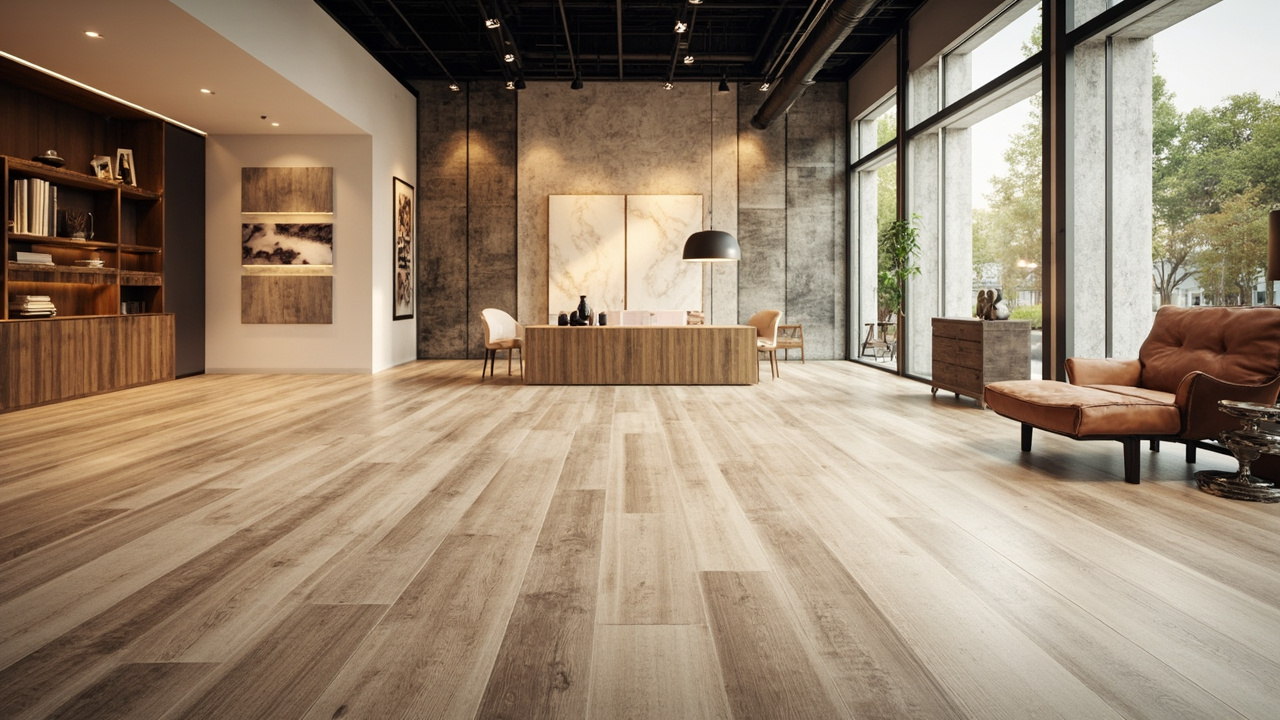
Solid Polymer Composite, better known as SPC, has taken over the value and mid-range flooring market in a decade. It is waterproof, dimensionally stable, fast to install, and inexpensive to ship as flat-pack cartons. China now produces most of the world's SPC, concentrated in Hubei, Zhejiang and Jiangsu, but the gap between a floor that holds its click joint for ten years and one that opens up after one season of air-conditioning is measured in wear layer, click design and UV coating. This guide sorts the export-grade factories into ten archetypes so a buyer can match a supplier to the project.
What defines an export-grade SPC factory
Five numbers tell most of the story. The core thickness: 4, 5 or 6 millimetres, with 5 millimetres the export standard for residential and light commercial. The wear layer: 0.3 millimetre for residential, 0.5 for commercial, 0.55 and above for heavy commercial, where thicker means longer life. The attached underlayment: IXPE or EVA foam in 1.0 to 1.5 millimetres that cushions impact and dampens sound. The UV coating: a UV-cured polyurethane top coat, applied in multiple passes for scratch and stain resistance. The click system: a patented angle-and-fold or drop-lock joint (Unilin, Valinge or 5G) that lets the planks lock without glue.
The integrated export-volume groups
At the top sit vertically integrated groups that run their own PVC compounding, extrusion lines, UV coating and cutting. They hold FloorScore, GREENGUARD, CE and Fire Class Bfl-s1 certificates, and they ship thousands of containers a year to North America, Europe and Australia. These are the default partners for large residential and hotel projects where consistent colour across thousands of square metres matters and where the buyer needs a warranty backed by a factory that will still exist in five years.
The embossed-in-register specialists
A second tier focuses on surface realism. These factories calibrate the embossing roller so precisely that the texture follows the printed wood grain line by line, a technique called embossed in register (EIR). The visual effect is indistinguishable from real oak at one metre, and EIR is now the standard for any mid-range SPC aimed at residential living rooms. The factory invests in the printing cylinder and the embossing die, and the colour range is wider than the volume producers offer.
The heavy-commercial and fire-rated specialists
Some factories specialise in SPC for commercial floors: retail, office, hospital and airport. They run a thicker wear layer (0.5 to 0.7 millimetre), a denser core (specific gravity above 0.55) and a fire-rated formulation that meets EN 13501-1 Class Bfl-s1 or ASTM E648 Class 1. They also test for castor chair resistance (EN 425) and static load (EN 433). For any project that will see wheeled traffic or fire-code inspection, this is the archetype that passes the certificate.
The loose-lay and hybrid specialists
A focused category produces loose-lay planks (with a friction grip backing, no glue and no click) and hybrid floors that combine a rigid SPC core with a real wood veneer top. The loose-lay product targets renovation projects where glue-down is impractical, and the hybrid targets the premium residential segment where the buyer wants the warmth of real wood with the stability of SPC.
How to qualify an SPC supplier
Before requesting prices, send the destination country, the project type, the target colour and thickness, the wear layer required, the certification (FloorScore for the US, CE for Europe, GREENGUARD for sensitive indoor air) and the quantity per container. Ask for the certificate of the wear layer thickness (checked with a micrometre on the cross-section), the click system patent licence, the fire test report for the commercial spec, and a one-square-metre sample of each colour. Test the sample: smell it for off-gassing (a formaldehyde smell means reject), bend a plank to check click flexibility, scratch the surface with a coin to check the wear layer, and leave a drop of mustard for an hour to check stain resistance. Then shortlist two factories of different archetypes and decide on warranty and after-sales rather than on the per-square-metre price. Sourcing SPC direct from China still saves 30 to 50 percent against a regional distributor, but only when the buyer treats the wear layer, the click licence and the certificate as the three non-negotiables.