





Top 10 Fluted Wall Panel Manufacturers in China
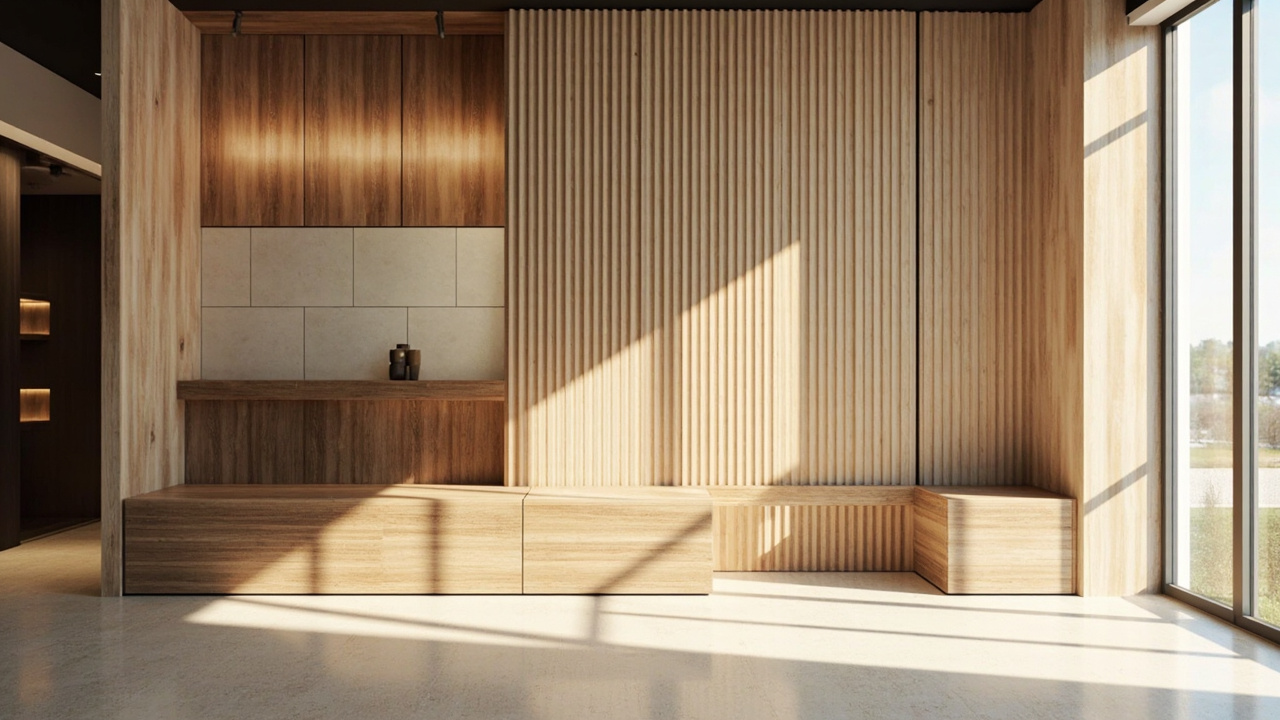
The fluted wall panel, a slatted timber or composite face over a felt or acoustic backing, has moved from the boutique hotel reception to the residential feature wall in five years. China now produces the bulk of the world's fluted panels, concentrated in Guangzhou, Foshan and Chengdu, but the gap between a panel that stays flat and looks the part after five years and one that warps, fades and delaminates is measured in core material, slat profile and backing. This guide sorts the export-grade factories into ten archetypes so a specifier can match a supplier to the room.
What defines an export-grade fluted panel factory
Four numbers tell most of the story. The slat: a solid wood or MDF slat 15 to 30 millimetre wide and 8 to 15 millimetre thick, with a real wood veneer (0.6 millimetre) or a lacquered finish. The backing: a black or grey PET felt (recycled polyethylene terephthalate) of 7 to 9 millimetre thickness, or a black acoustic fleece over an MDF base. The acoustic performance: a Noise Reduction Coefficient of 0.4 to 0.7 measured at 100 to 5000 hertz. The panel format: a 600 by 2400 millimetre or 600 by 2700 millimetre sheet, with the slats pre-mounted and ready to fix to the wall.

The integrated slat-and-felt groups
At the top sit vertically integrated groups that run their own slat-machining lines, their own felt-pressing lines and their own veneer lay-up lines. They produce the complete panel range (full-sheet ready-to-mount, tongue-and-groove jointed, curved for columns) and they hold FSC chain-of-custody, CARB P2 for the MDF and an acoustic test report. These are the default partners for hotel groups, large office fit-outs and developer projects where uniformity across hundreds of square metres and warranty back-up are non-negotiable.
The wood veneer specialists
A focused archetype is the wood veneer specialist. The slat is a real wood veneer (0.6 millimetre thick, from American walnut, European oak or smoked eucalyptus) laid up over an MDF core. The craft is in the veneer selection (an even colour across the panel, with the slats matched to look continuous), the lacquer (a UV-cured matte PU that resists scuff), and the slat profile (a shallow V-groove between the slats to give shadow, or a flat face for a cleaner look). They are the right call for the residential feature wall, the boutique hotel reception, and any project where the panel is meant to look like real wood, not printed.
The acoustic and PET-felt specialists
Another archetype specialises in acoustic performance. The product is a slat panel over a thick PET felt backing, designed to absorb mid- and high-frequency sound in an office, a meeting room, a restaurant or a hotel lobby. The craft is in the felt density (a 9-millimetre PET felt of 1500 grams per square metre), the slat spacing (wider spacing exposes more felt and absorbs more sound), and the test report (a Noise Reduction Coefficient measured in a reverberation chamber, not just a sales claim). They are the right call for the contract office fit-out, the restaurant, and any project where acoustic performance is written into the spec.
The melamine and laminate value producers
A broader tier produces melamine-faced and laminate-faced fluted panels. The slat is an MDF slat with a melamine-impregnated paper or a high-pressure laminate face, printed to look like wood. The unit cost is lower, the colour range is wide (oak, walnut, grey, black, in dozens of tones), and the panel is moisture-resistant and scratch-resistant. They are the right call for budget residential, for retail fit-outs, and for projects where the panel takes daily wear and a real-wood veneer would mark.
How to qualify a fluted panel supplier
Before requesting prices, send the wall area, the slat width and spacing required, the wood species or finish, the backing type (PET felt, acoustic fleece or MDF), the panel format (sheet size, tongue-and-groove or butt-jointed), the fire rating required (Class A or B, for commercial), and the quantity. Ask for the slat material certificate (solid wood, MDF, named species), the veneer thickness certificate (0.6 millimetre minimum for real wood), the felt density certificate (grams per square metre), the acoustic test report (NRC measured in a reverberation chamber), the formaldehyde emission certificate (CARB P2 or E0 for the MDF), the fire rating certificate (Class A or B) and a full-size sample panel. Test the sample: weigh it to confirm density (a 600 by 2400 millimetre panel should be 14 to 22 kilograms depending on backing), drag a fingernail across the slat to check the veneer bond (no lifting), press a thumb into the felt to check resilience (it should spring back), leave a tea-bag of water on the felt for an hour and check for staining, and stand the panel against a wall and check for bow. Then shortlist two factories of different archetypes and decide on slat material and backing type rather than on the per-square-metre price. Sourcing fluted panels direct from China still saves 30 to 50 percent against a regional distributor, but only when the buyer treats the slat material, the felt density and the acoustic test as the three non-negotiables.