





How to Import Marble and Granite from China: Slab Grading and Shipping

Importing marble and granite from China looks deceptively simple until the first container of cracked slabs arrives at the port. Natural stone is the one product category where beauty, fragility and weight combine against the buyer, and where the gap between a premium slab and a reject slab is judged entirely by eye. The buyers who succeed treat stone sourcing as an inspection-heavy process: they grade, they treat, they match, and above all they pack with the same care a museum would give a sculpture.
Slab grading: the A, B, C of natural stone
Every Chinese quarry and factory sorts slabs into commercial grades, and the difference between grades is the single biggest price driver. Grade A slabs are colour-consistent, free of hairline cracks and veins that telegraph weakness, and carry minimal filling. Grade B allows moderate colour variation, visible veins and a limited amount of resin-filled pitting. Grade C, often sold at a forty percent discount, includes slabs with structural fissures, heavy filling and dramatic colour swings that look fine in a photo but fail on a kitchen island. The trap is that a photo cannot show grading: a Grade C Calacatta can look identical to a Grade A in a backlit thumbnail. The only protection is to specify the grade in the contract, request a video walk-through of the actual bundle selected for your order, and book an independent inspector to sign off the slabs before they are loaded.
Resin treatment, book-matching and thickness tolerance
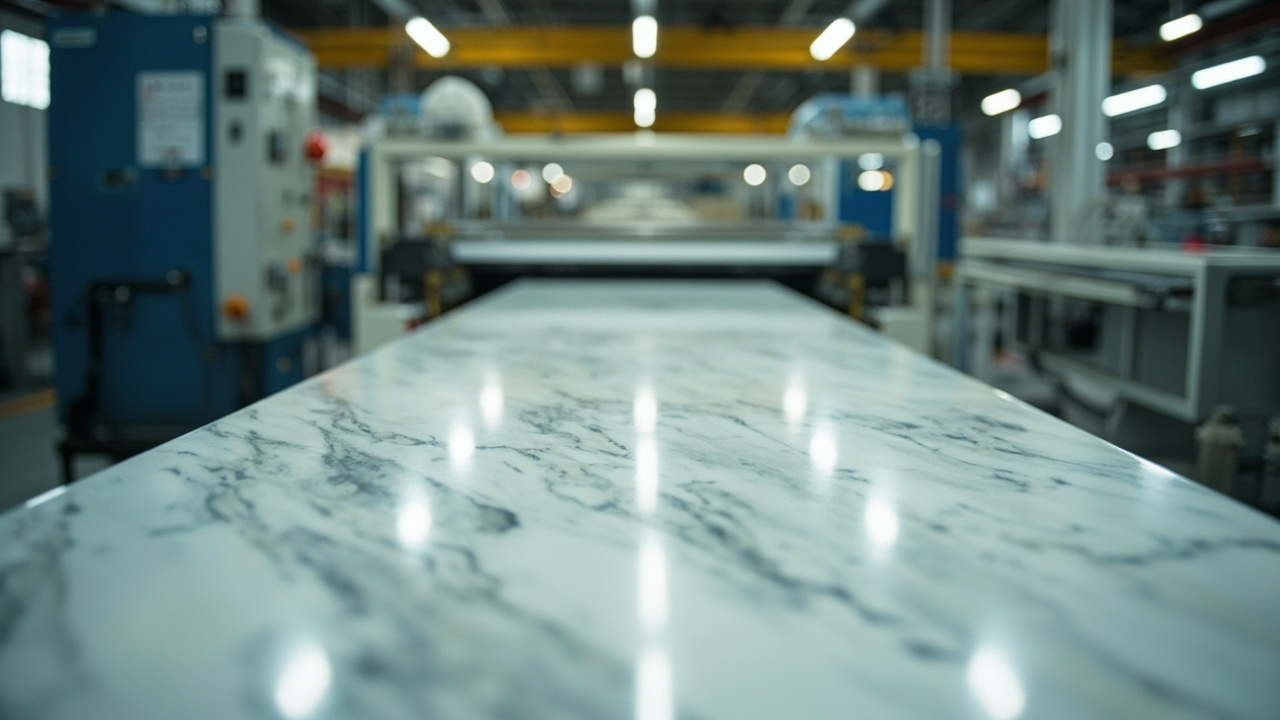
Two production steps separate a flat slab from a finished product. Resin treatment — usually epoxy or polyester brushed onto the back of the slab and vacuum-impregnated into fissures — strengthens fragile marbles such as Calacatta and Crema Marfil enough to survive cutting and transport; insist on it for any marble with visible veining. Book-matching is the practice of cutting adjacent slabs from the same block and polishing them as mirror pairs, so the vein pattern flows continuously across two or four slabs. For feature walls and reception desks, book-matched sets command a premium but deliver a look that single slabs cannot match. Thickness tolerance is the silent killer: the industry standard is plus or minus one millimetre on an eighteen-millimetre slab, but budget factories cut to plus or minus three, which leaves visible lips on butt-jointed countertops. Specify the tolerance in writing and have it checked with a calliper at inspection.
LCL versus FCL, and the A-frame crate
Stone should almost always ship as a full container load (FCL). Less-than-container-load (LCL) shipments are consolidated with other cargo, and the forklift handling at the consolidation warehouse is the single most common cause of breakage: a pallet of tiles stacked on top of a bundle of slabs will crack the slabs below it. Inside the container, slabs must be packed standing on A-frame racks — steel or timber frames shaped like the letter A that distribute the weight evenly and prevent the slabs from flexing. The slabs should be separated by foam or polystyrene sheets, strapped tightly to the frame, and wedged so they cannot slide during the three-week sea voyage. A container loaded correctly can be dropped from a forklift with minimal damage; a container loaded loosely will arrive with cracks even if the ship never hits rough weather.
Breakage claims and the inspection that prevents them
Even the best-prepared shipment can arrive with damage, and the difference between a covered loss and an out-of-pocket disaster is the paperwork done before loading. Demand a pre-shipment inspection report that photographs each bundle, records the slab count, and notes the moisture content of any timber dunnage (dunnage above eighteen percent moisture can warp and crack the slabs). Insist on a marine insurance policy that covers the full replacement value of the stone, not just the invoice value, because a broken Calacatta slab may now cost more to replace than it did to buy. When the container arrives, inspect it before signing the delivery note: photograph any visible damage to the container shell, count the bundles against the packing list, and document any broken slabs with their bundle number within the first forty-eight hours, since most insurance policies require notice within a short window.
Stone is the most rewarding category a project buyer can source from China, and also the least forgiving. The buyers who win are the ones who treat grading as a contractual term, who insist on resin treatment for fragile marbles, who pay the small premium for full-container A-frame packing, and who document the shipment so thoroughly that any breakage becomes an insurance claim rather than a loss. Done this way, a Chinese marble order can deliver twenty square metres of Calacatta for the price of five metres bought locally.